- Home
- Artificial Intelligence
- What Happens When AI Agents Start Working Together?
What Happens When AI Agents Start Working Together?
- July 27, 2026
- XequenceAI
- Artificial Intelligence, Business Automation Tools, Digital Concierge
AI Agents Working Together: The Future of Intelligent Automation
Enterprise AI for years worked like a stocking smart intern that was useful at a specific question but didn’t get much done once the job went beyond the cubicle walls. A chatbot might compose an email, write down a report or get a policy. However, it was not able to detect that supplier delays caused any impact to inventory, customer commitments, staffing or cash flow and then coordinate a response across all functions.
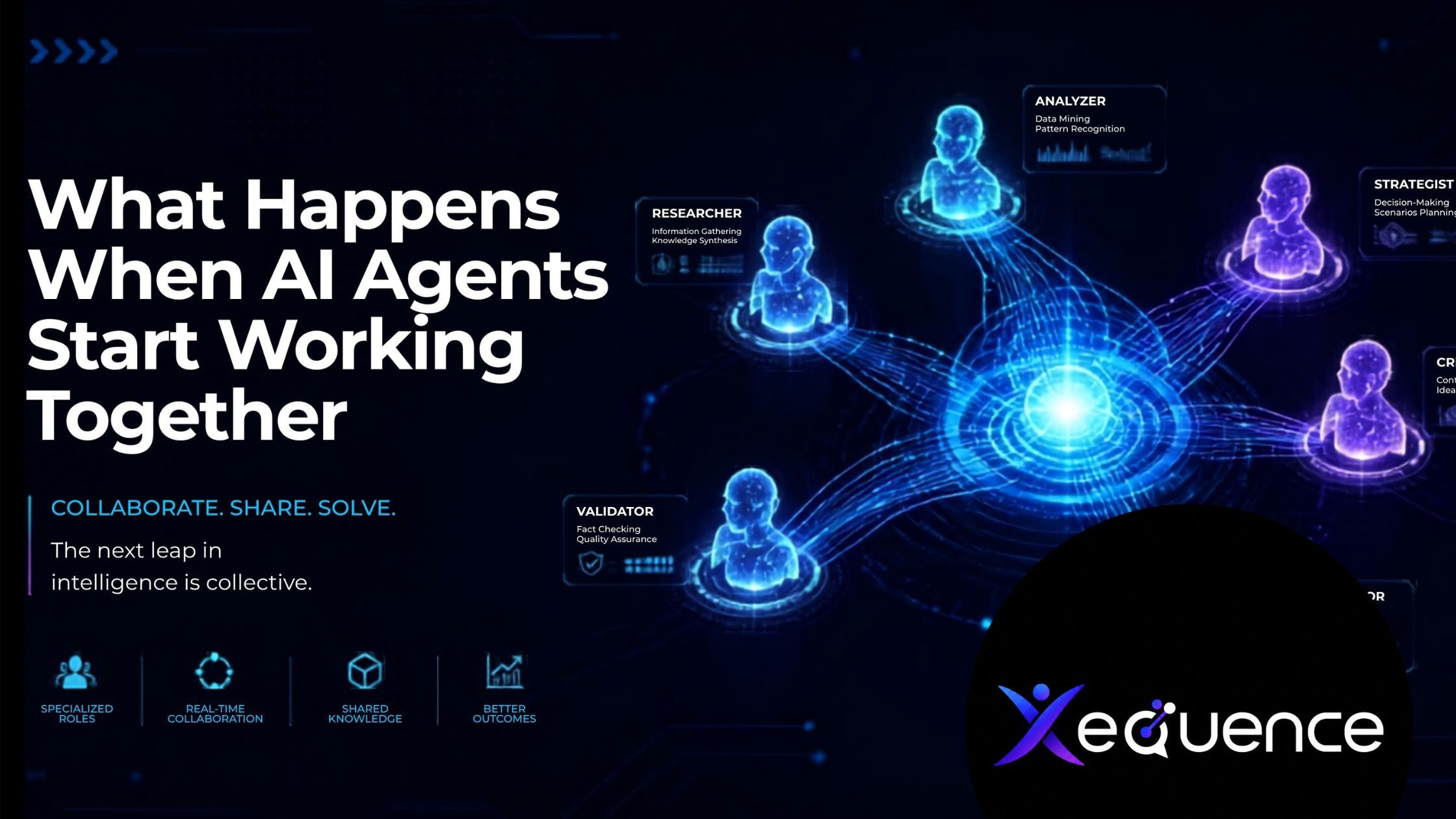
The current limitation is being replaced by a more impactful model: networks of AI agents that can split up tasks, share context, coordinate priorities, and perform bounded actions. The technical story is important. The human story is larger. When AI agents begin working together, they do not simply accelerate tasks; they attack the administrative noise that consumes modern work.
From the Helpful Chatbot to the Working Network
The first versions of workplace AI were primarily conversational. They answered questions and took specific commands from people and then handed off to the next level of human decision-making. It reduced effort at the margins but left the coordination burden untouched.
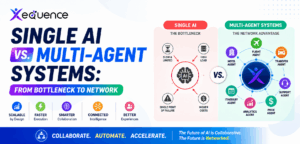
Multi-Agent Systems change the unit of work. Rather than creating one assistant to rule them all, companies could create specialized agents that work in concert. One could keep track of suppliers, another could plan production, a third could calculate the financial implications on the company’s margin, while a fourth prepares messages to customers. The secret to success is not individual genius but organization.
- Single-prompt AI: A response that is generated after compiling the context by the human
- Multi-agent orchestration: Capturing the context, delegating, testing variants, and returning only the judgments for the human to act on
The difference is akin to a calculator versus an operations center. One answers a question. The other helps the organization move.
The Hidden Cost of Human Coordination
Most process inefficiencies are not caused by an absence of required skills. Usually, the problem comes down to the amount of effort needed to apply these skills. The application of expertise in the right place at the right time consumes a lot of time by employees. People waste hours searching for the updated version of a plan, interpreting data for their colleagues, setting up meetings, asking for approval, and recording decisions for those who did not attend them.
Traditional human-in-the-loop workflows create a familiar relay race. A sales manager flags a risk. An analyst rebuilds the numbers. Operations checks capacity and finance asks for assumptions. Legal reviews language. By the time the organization agrees on a response, the underlying conditions may have changed.
This is administrative drag: the invisible tax paid to keep work synchronized. It produces frustration because employees are asked to act as routers, translators, and memory systems rather than problem solvers. The organization may call this “collaboration,” but much of it is Coordination Theatre.
How Agents Negotiate, Delegate, and Resolve Conflict
Collaborative agents are general-purpose systems, designed to make coordination a competence rather than a burden to humans. An orchestration layer provides agents with a shared view of the world, specifying mutual goals, permissions, policies, and past actions. By working within these constraints, agents can delegate, negotiate, and request additional information to resolve disagreements and achieve confidence in results.
Consider a manufacturer facing a late shipment of a critical component. A supply-chain agent can identify alternatives; a production agent can calculate schedule effects; a finance agent can compare expedited freight against lost revenue; and a customer agent can identify affected accounts. The agents may be conflicting, because they pursue different objectives. The system is not designed to eliminate the conflict, but instead to expose the conflict in a particular way, by maintaining a margin, protecting strategic customers, or other means.
Operational friction points agents can absorb:
- Chasing status updates across disconnected systems
- Reconciling conflicting spreadsheets and definitions
- Routing work to the right owner
- Repeating the same context in meetings, tickets, and email threads
- Escalating only after a preventable delay becomes urgent
The result is not autonomous consensus at any cost. It is a faster, more legible disagreement.
The Battle Between Architecture and Reality
The enterprise has historically organized communication around hierarchy: reporting lines, approval chains, functional systems, and scheduled meetings. Data, however, does not respect those structures. Demand spikes at midnight. A port closes. A customer changes an order. A regulatory requirement arrives while teams are still debating last quarter’s forecast.
This creates a persistent battle between rigid communication infrastructure and volatile real-time environments. Traditional workflows attempt to make reality wait for the organization. Agent networks reverse the premise: they allow the organization to respond at the speed of reality.
That requires disciplined architecture. Agents without clear limitations, reliable access to information and audit trails, control over identities, and specific instructions on what to do in various circumstances are more likely to create chaos than order. Left on their own with only vague guidelines, a network of agents is not an independent supply chain but a self-organized meeting that nobody wanted to attend.
Autonomous Supply Chains—and the Return of Human Judgment
By 2026, enterprises will use coordination of various multi-agent systems for supply chains, customers, cybersecurity, financial planning, software development, and human resources. In complex cases, these agents can recognize the impending crises, model potential alternatives, make a reserve of critical inventory, notify vendors, adjust forecasts, and prepare customer support before a shift manager reviews a report.
Such automation aims to deliver the consumer-like convenience of work, removing the need to navigate various dependencies and think through every detail. It helps to make day-to-day operations more intuitive, leaving more important cognitive effort for tasks requiring human judgment.
At the same time, the term cognitive relief does not mean replacing humans with algorithms when it comes to judgment. The responsibility for making ethical choices and solving unsolved problems remains with humans. The most effective design is not “human versus machine.” It is a division of labor in which agents manage coordination density and humans decide what the organization should value when objectives collide.
Conclusion: Coordination Becomes a Product
When AI agents start working together, the central transformation is not that companies gain more automated tasks. They gain a new operating model for coordination. The previous view of communication is seen as a set of stages through which people can pass information. It includes handovers, approvals, and reminders. The new model perceives communication as an interactive paradigm that involves observing, delegating, negotiating, and escalating processes.
The companies with the most value will not be those that rely on the greatest number of agents. On the contrary, it will be those that rethink the process and design it in a way that establishes clear expectations and accountability, leveraging human capacity wherever or whenever it creates the most value. Multi-agent orchestration can turn the burden of complexity into a competitive differentiator by transforming the enterprise from a taxi for employees’ decisions into a personal assistant. It creates the precious space in which an employee can operate their mind on the matters that require judgement.
Recent Posts
The Rise of Autonomous Coordination Infrastructure: Powering the Future of AI
Rajib Kar
July 10, 2026
Newsletter
Get regular updates on data science, artificial intelligence, machine
You may also like
The Blueprint of Autonomous Operations
Rajib Kar
July 16, 2026
The Rise of Autonomous Coordination Infrastructure: Powering the Future of AI
Rajib Kar
July 10, 2026
Single AI vs. Multi-Agent AI: A Complete Enterprise Guide
Suraj Kumar
July 8, 2026
Enterprise Operations & Data Silos: The AI Solution for 2026
XequenceAI
June 25, 2026