- Home
- Artificial Intelligence
- Single AI vs. Multi-Agent AI: A Complete Enterprise Guide
Single AI vs. Multi-Agent AI: A Complete Enterprise Guide
- July 8, 2026
- Suraj Kumar
- Artificial Intelligence, Business Automation Tools, Technology
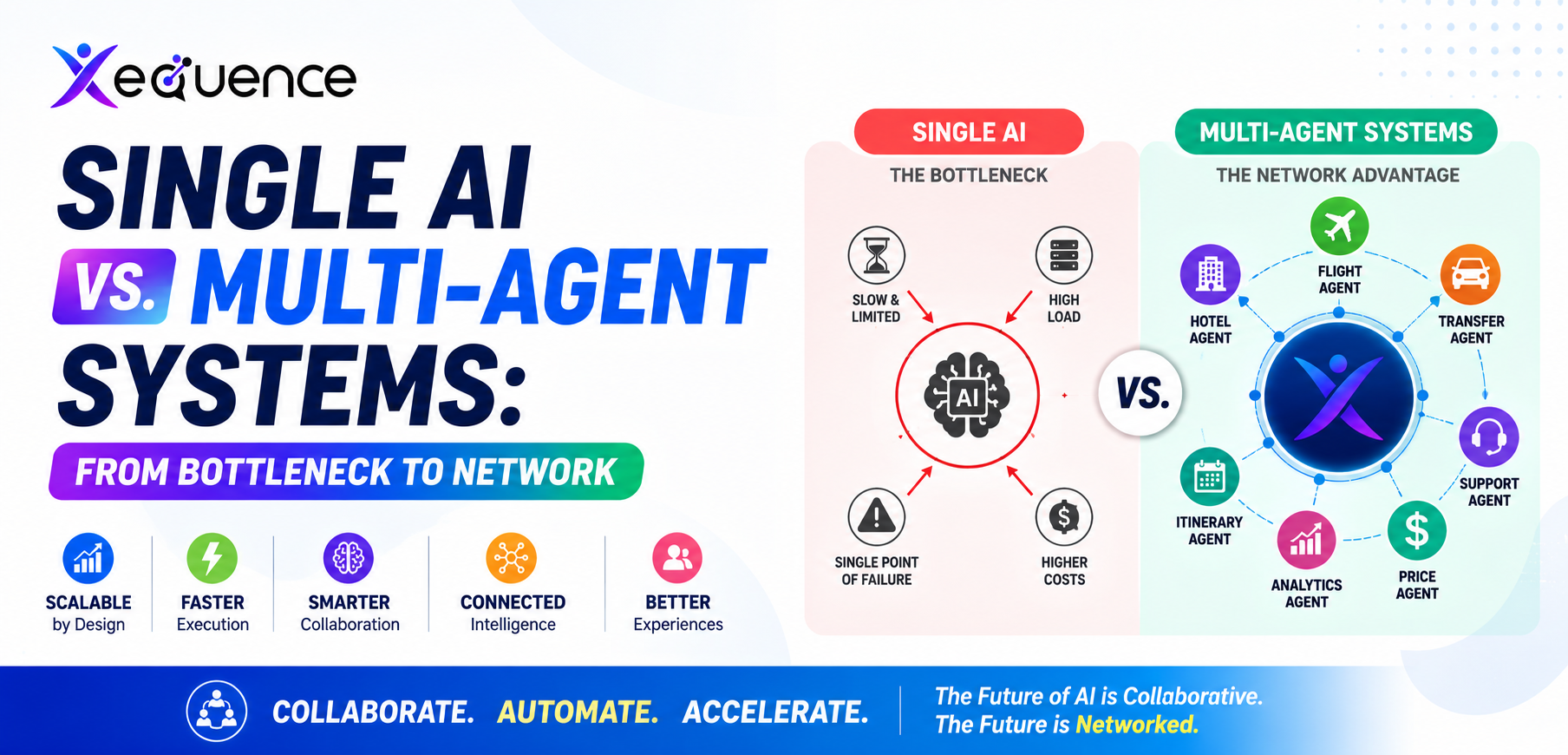
Single AI vs. Multi-Agent Systems: From Bottleneck to Network | The Future of Enterprise AI
For years, enterprise AI has been predicated on an appealing promise: one model to rule them all, a monolithic system that could serve as the central nexus of the enterprise and provide answers to any question. This could take the form of a model that can summarize a contract, draft an email for a sales executive, analyze a spreadsheet, write code, and even suggest a strategic initiative. The value proposition was clear: a single point of interaction and a vastly reduced complexity in an environment where users were already struggling to manage dashboards, emails, approvals, and multiple other tools.
The problem with this approach is that the complexity isn’t eliminated—it’s just moved somewhere else. A general-purpose model that is expected to perform all these tasks is typically not as good at any of them compared to a specialized model. It is like asking an air-traffic controller to also be a commercial pilot and a baggage handler—while they can perform all these roles, their performance in each will be diminished due to the added multitasking. A single model has to remember, retrieve, interpret, execute, prioritize, and report—in other words, perform a variety of tasks while the underlying dynamics of the system are changing constantly. The promise of one-stop shopping may be appealing, but the result is typically less effective solutions.
When Context Starts to Fray
The central weakness of single-AI architecture is not raw intelligence; it is concentration. A monolithic approach should maintain context across the larger series of dialogues and provide for multiple roles (researcher, analyst, compliance reviewer, project manager, and writer). Each new request or instruction will cancel out the previous one, and the likelihood of missing, misunderstanding, or losing details becomes increasingly high.
This is where context drift enters. A model may begin with a clear understanding of a customer requirement and then lose precision after several turns involving policy exceptions, data updates, and formatting requests. Hallucinations are more likely to arise not from a failure to know something, but by the need to improvise over too great a distance. Employees are then left to do the checking, explaining, and correcting that the system should have done itself.
The Human Cost of Prompt Noise
The operational consequences are deeply human. Workers do not suffer from the same type of AI failure, as it’s described as an architectural problem; it’s a friction they suffer. They spend time on rephrasing prompts, copying and pasting background information into new chats, checking over their answers, making sure they’re confident but not necessarily accurate, and making sure they understand their results and can back it up with some concrete information. “Automation” turns to more administrative tasks.
Traditional prompt engineering often amplifies this burden. Users get taught to layer instructions as though they were sandbags: Give the instruction. Tell who the users are; Give the information to the user; State the restrictions; Ask for citations; insist that it be a certain format; then restate the process if the model gets lost in the instructions. The prompt is now a small document for learning how to use the system, and the employee is the only unwilling systems integrator.
The Real World Refuses to Be Neat
Enterprise workflows do not unfold in clean, linear sequences. Data comes late, customers change their minds, regulations change, systems don’t agree, and exceptions proliferate. The problem is that one model works best when there’s a well-lit boardroom while the real world is more like a crowded trading floor in a hurricane.
This is the battle at the heart of AI architecture. Rigid computational constraints demand a coherent prompt, a defined task, and accessible information. Ambiguity, competing signals and multiple ownerships will occur in real-world environments. It’s like the finance, operations, legal, customer service, and cybersecurity executives are all one, and that model is expected to handle all of that volatility. The problem is not of the quality of the executive but of the structure’s design for the work.
The Rise of the AI Network
Multi-agent system design offers a fundamentally different approach to the grand challenge of artificial intelligence. Instead of attempting to encode all of human knowledge and reasoning into a single monolithic entity, this approach breaks the task down into related subtasks. Then, it tackles each of these smaller challenges with a dedicated agent. Some agents might perform research and information-gathering, while others evaluate that information, apply policy, or make a final recommendation. An orchestration layer delegate’s work, routes information between agents, and even raises concerns when the chain of reasoning appears to be flawed or reach beyond the bounds of acceptable belief.
This approach allows different AI agents to perform very different roles and makes the system more like a well-organized group of experts than a lone genius. This division of labor reduces the cognitive load on any single agent while the collaboration between agents helps prevent mistakes. Instead of forcing a single model to remember every instruction and execute every task, the system distributes work according to capability. The architecture turns AI from a conversational endpoint into an operational network.
Orchestration Replaces Improvisation
The value of multi-agent systems lies not merely in having more agents. A key aspect of orchestration lies in defining who does what, when, with what information, and under what constraints. A research agent can gather evidence, while a validation agent can assess it against the source material. Meanwhile, a decision agent can present potential options alongside confidence scores. The result is no longer an ad hoc improvisation but a carefully choreographed production.
This has concrete benefits for the humans who have to make sense of it all. Context switches become less frequent, meaning individuals can focus more on making decisions than on figuring out what’s going on. They can intervene at critical decision points rather than attempting to oversee every single action. In effect, orchestration doesn’t eliminate human judgment from the process—it relocates it to the points where it can have the most impact.
Conclusion: Designing for Work, Not Demos
This change from single AI to multi-agent systems is more of a transition from showmanship to infrastructure. Single models will continue to be useful when working on a focused task, for fast drafting and individual productivity. But organizations that expect AI to navigate complex, high-stakes workflows need an architecture that reflects the distributed nature of the work itself.
Multi-agent networks provide that architecture. They replace the brittle fantasy of one model doing everything with a more resilient model of coordinated specialization. In the coming years, it’s not going to just be the biggest companies that have the advantage. It will be one of the ones that create AI systems that can smoothen down human friction, deal with uncertainty, and convert the noise in an operation into synchronized action.
Recent Posts
The Rise of Autonomous Coordination Infrastructure: Powering the Future of AI
Rajib Kar
July 10, 2026
Newsletter
Get regular updates on data science, artificial intelligence, machine
You may also like

What Happens When AI Agents Start Working Together?
XequenceAI
July 27, 2026
The Blueprint of Autonomous Operations
Rajib Kar
July 16, 2026
The Rise of Autonomous Coordination Infrastructure: Powering the Future of AI
Rajib Kar
July 10, 2026
Enterprise Operations & Data Silos: The AI Solution for 2026
XequenceAI
June 25, 2026